
How NIST CSF 2.0 Aligns with the Smart Access PAM Maturity Framework
From Global Framework to PAM-Specific Maturity
NIST CSF 2.0 sets the global standard for managing cyber risk, but it is broad by design. Privileged Access Management (PAM) is one of the highest-impact areas of cyber risk, yet often lacks practical detail in the framework. The Smart Access PAM Maturity Framework bridges this gap by mapping NIST CSF 2.0 Functions, Categories, and Subcategories directly into the context of PAM. This creates a clear, measurable maturity journey — from Non-Existence to Optimised — that aligns PAM strategy with compliance, board reporting, and Zero Trust goals.
High-Level Mapping of NIST CSF 2.0 Functions
Where Global Standards Meet Privileged Access
Each NIST CSF 2.0 Function is translated into practical Privileged Access Management (PAM) requirements within the Smart Access PAM Maturity Framework. This ensures privileged access risks are managed in line with global standards, while providing a structured path for measurable maturity.
Govern (GV) - In the context of PAM, we meet ensure policies, oversight and accountability for privileged access are in-place and risk exceptions are tracked.
Identify (ID) -
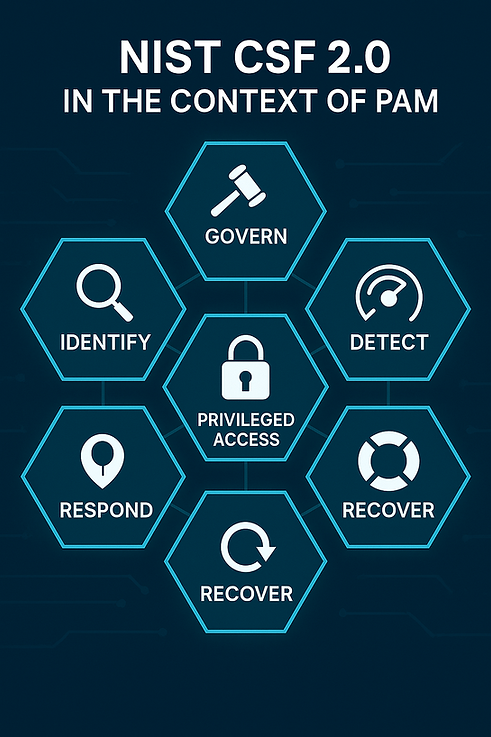
NIST CSF 2.0 in the Context of PAM
The Six Functions and Where PAM Fits
NIST CSF 2.0 defines six core functions that structure how organisations manage cybersecurity risk. Each has direct relevance to Privileged Access Management:
-
Govern (GV): Establish governance, policies, and risk oversight.
-
PAM Strategy Alignment: Define who should have privileged access, under what conditions, and how risk exceptions are managed.
-
-
Identify (ID): Understand assets, risks, and dependencies.
-
PAM Strategy Alignment: Discover privileged accounts across infrastructure, applications, and third parties.
-
-
Protect (PR): Safeguard identities, access, and data.
-
PAM Strategy Alignment: Enforce least privilege, just-in-time access, and MFA for administrators.
-
-
Detect (DE): Monitor for anomalies and threats.
-
PAM Strategy Alignment: Spot unusual privileged activity, lateral movement, or credential misuse.
-
-
Respond (RS): Contain and mitigate incidents.
-
PAM Strategy Alignment: Revoke compromised credentials, cut off malicious sessions, and coordinate response.
-
-
Recover (RC): Restore operations and resilience.
-
PAM Strategy Alignment: Reinstate secure privileged access and communicate recovery status after an incident.
-
The Business Value of Alignment
Compliance, Confidence, and Resilience
Aligning PAM with NIST CSF 2.0 delivers:
-
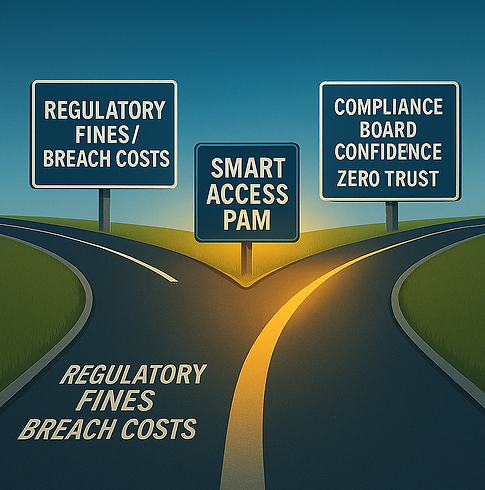
Regulatory compliance with NIS2, DORA, UK Cyber Resilience.
-
Board-level confidence through risk-based reporting.
-
Audit success with measurable maturity indicators.
-
Reduced dwell time for advanced threats.
-
Alignment to Zero Trust strategies without vendor lock-in.
Smart Access PAM makes these outcomes practical, measurable, and sustainable.
Take the Next Step
From Awareness to Measurable Action
Take the next step:
-
Download the Smart Access PAM Blueprint (free).
-
Book a free 30-minute discovery call to discuss how the Smart Access PAM Blueprint — built on NIST CSF 2.0 — can be applied to your organisation’s PAM strategy.